Range Repair
Getting a 48-Inch Viking Into a LoDo Warehouse Loft: Freight Elevators, Timber Floors and the 1988 District Ordinance
A 48-inch Viking in a LoDo warehouse loft is serviced around the building — one freight elevator, a fixed car opening, timber floors, and a 1988 ordinance that rules out altering the exterior. Most range faults, though, are still fixed where the appliance stands.
Written by Clifford Nakamura Service technician — controls and intermittent faults · 22 years in the trade
Denver City Council passed the Lower Downtown Historic District ordinance in 1988, putting demolition controls and design guidelines over a district of brick-and-timber warehouses raised between the 1880s and 1900s. The residential stock in LoDo is those warehouses, converted. The movement started in 1980, when the Spice and Commercial Warehouse at 1738 Wynkoop Street became lofts.
A 48-inch Viking range is a several-hundred-pound rigid box that should not be laid on its back — the burner assembly and the door glass are not structural. Everywhere else in Denver that is a two-person problem. In a converted warehouse it is a building problem, and the building has opinions.
That changes what a repair looks like here. Not the fault, not the parts, not the skill. The sequence.
The call we take most often here
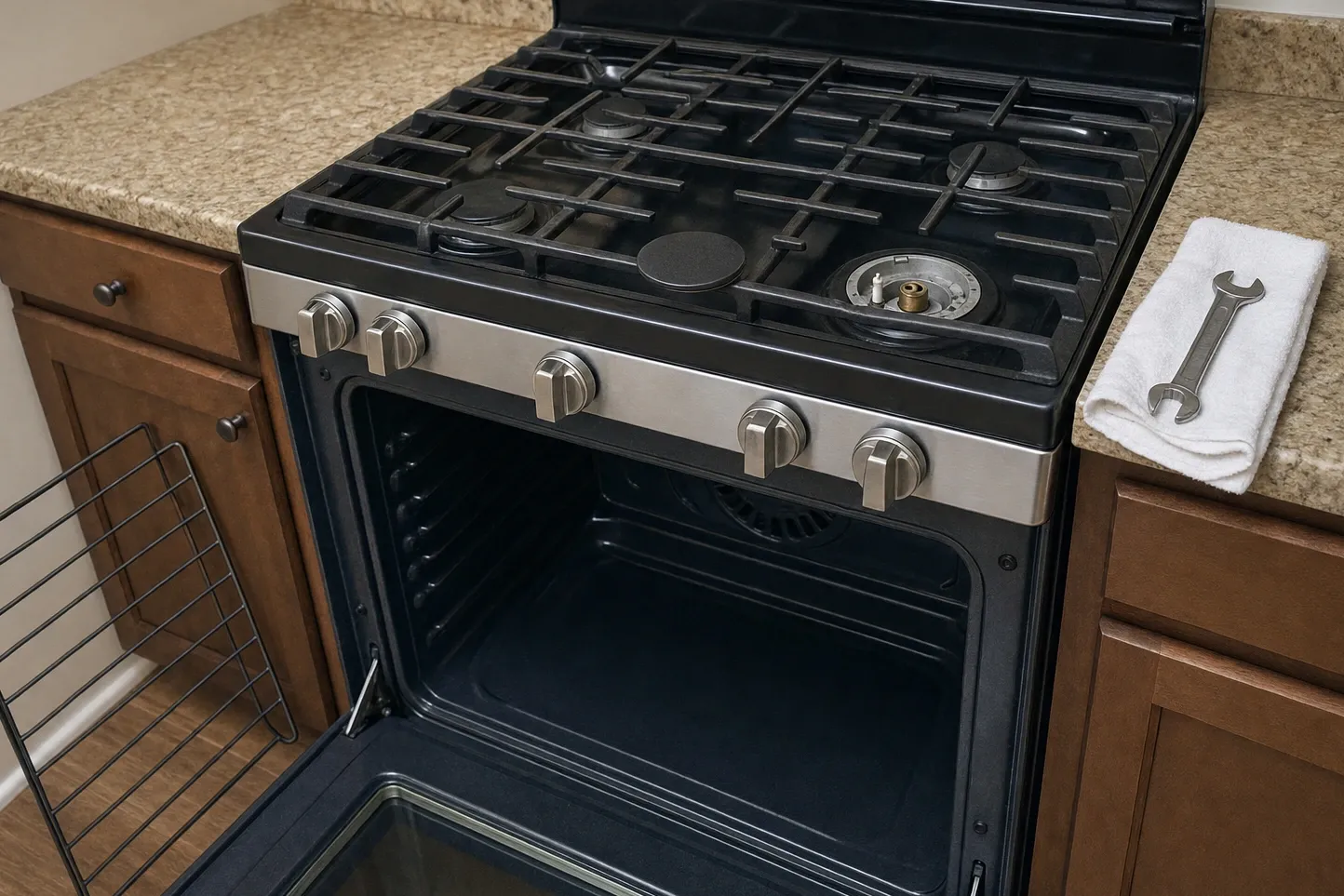
A burner that sparks over and over and never catches. A simmer that drops out the moment the vent runs. A flame burning tall and orange instead of tight and blue. A knob gone stiff with the valve seized behind it. Ordinary Viking faults, all of them, and most are resolved in place.
What is not ordinary in LoDo is the small subset that needs access to the back or the underside of the appliance, because reaching either means the range travels — and in these buildings travel is scheduled by somebody else.
Why this address produces it
Three physical facts, none of them negotiable. One freight elevator per building, with a fixed car opening and a fixed interior clear height. Heavy-timber floor structure, which in older conversions carries a real limit on concentrated point loads. And a street or alley frontage with no residential loading dock, which puts the truck in a traffic lane on a permitted window rather than at a bay.
The 1988 ordinance adds the fourth. Because it governs alterations to the exterior fabric, the workaround used routinely in ordinary houses — take out a window, widen a door opening, bring the appliance in through the wall — is simply not available. The route through the building is the only route there is.
Central Park, Congress Park and Berkeley all have their own access problems, and they are different in kind. A Central Park house usually offers a garage and a level run to an open kitchen. A Congress Park bungalow or Denver square has a tight original footprint but a front door you can measure. A Berkeley pop-top has a stair and a narrow galley. In all three, the constraint is dimensions. In LoDo the constraint is dimensions plus a calendar you do not control.
The chain, from cause to complaint
The order runs building first, appliance second. Elevator availability sets the appointment slot, which is why we ask for the management contact before we ask about the fault. The car opening decides whether a 48-inch unit can travel assembled or has to be field-stripped — doors off, backguard off, side panels off, and on the tightest cars the top as well.
Stripping is routine work, but it is not fast, and it is the honest reason a job that would be one visit in a bungalow can become two in a warehouse loft. If a part has to be identified with the unit out and then ordered, the return trip needs the lift booked again.
The timber floor matters at the end of that sequence rather than the start. Rolling several hundred pounds across a hundred-and-twenty-year-old plank deck is done on load-spreading boards, and the route across the floor gets planned with the same care as the route through the door.
Ruling out the obvious first
Most Viking range faults never reach any of that, and it is worth knowing which ones. Repeated sparking with no light is usually the electrode, its gap, or a burner port blocked by boil-over — an igniter or burner assembly job at $180 to $440. Tall orange flames and lost simmer point at the burner air and orifice setup, which in Denver has to suit the thinner air the range is actually breathing rather than a sea-level default it may still be carrying.
An oven that heats badly or not at all is usually the thermostat or the element, at $210 to $440, and both are reached from the front. A dead or scrambled display is the control board or touch panel at $440 to $660. A stiff knob is a valve that needs cleaning and regreasing, not a new range.
Every one of those is diagnosed with the appliance where it stands. Establishing that first is the cheapest thing anybody does on the job, because it is what keeps the freight elevator out of the conversation entirely.
When it stops being a homeowner job
Anything with a spark module live, a gas connection opened, or the unit off its feet is where the homeowner stops. Gas work is not a place for experiment, and a 48-inch range that shifts on a stair is a serious injury waiting to be reported.
What we ask for when you book in a converted building: the building’s service-elevator rules, the car opening, whether there is alley access, and a photograph of the range in its opening. That handful of details is usually the difference between one visit and two, and it costs nothing to send.
The service call is a flat $89 and covers the trip and the full diagnosis, wherever in the district you are. Viking Repair Denver takes calls for LoDo, Central Park, Congress Park and Berkeley on (303) 729-0972.
Follow-up questions
- Does my 48-inch Viking have to come out of the kitchen for a burner repair?
- Almost never. Electrode gaps, blocked ports, igniter assemblies, burner valves and oven thermostats are all reached from the front with the range where it stands. Removal is for work at the rear or underneath. That distinction matters more in a warehouse loft than anywhere else, because moving the appliance means the freight elevator, and the elevator means a date the building chooses.
- Why does a LoDo appointment depend on the building?
- Because there is one freight elevator with a fixed car opening, no residential loading dock, and heavy-timber floors that limit how a heavy load crosses them. If a job needs the range to travel, the slot is set by elevator availability rather than by our route for the day. Sending the building's service rules when you book usually saves an entire visit.
- Does the 1988 historic district ordinance stop me replacing my range?
- No. The ordinance covers demolition and exterior design across the Lower Downtown district; it says nothing about which appliance sits in your kitchen. What it does remove is the workaround used in ordinary houses — taking out a window or widening an opening to bring an oversized unit in. Here the delivery route is whatever the building already provides.